Honoring Hand Talk: How Dr. Melanie McKay-Cody and Colin Denny Are Preserving Indigenous Sign Languages
November is Native American Heritage Month—a time to honor the histories, sovereignty, living cultures, and ongoing innovations of Indigenous peoples across Turtle Island. At Triangle, Inc., we believe that celebrating community heritage means recognizing its intersections with disability culture, communication access, and self-determination.
When most people think about sign language in the United States, they picture American Sign Language (ASL). Yet for centuries before European colonization, Indigenous nations across North America communicated through a rich network of distinct visual-manual languages collectively known as North American Indian Sign Language, or “Hand Talk.” Forced assimilation at Native boarding schools and Deaf residential schools pushed many of these ancestral sign systems to the brink of extinction.
This Native American Heritage Month, we are spotlighting two Deaf Native researchers—Dr. Melanie McKay-Cody and Colin Denny—who are combining community outreach and digital video archiving to preserve Indigenous sign languages for future generations, while reflecting on how Indigenous signing right here in Massachusetts helped shape modern Deaf history.
Dr. Melanie McKay-Cody: Guarding Ancestral Knowledge and Data Sovereignty
Dr. Melanie McKay-Cody, a Cherokee Deaf linguistic anthropologist (with maternal lineage connecting to Eastern tribes including the Shawnee, Powhatan, Montauk, Narragansett, and Pequot) and Assistant Professor in the Department of Disability and Psychoeducational Studies at the University of Arizona, began her research journey at age 10. After becoming deaf at age 5 from spinal meningitis, she picked up a library book at the Oklahoma School for the Deaf on Native American sign languages and immediately noticed how distinct those signs were from the ASL she used every day.
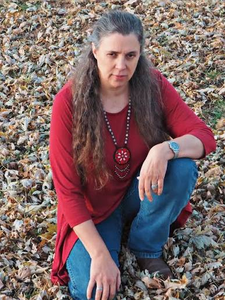
After earning degrees from Gallaudet University, the University of Arizona, the University of Kansas, and a Ph.D. in sociocultural and linguistic anthropology from the University of Oklahoma, Dr. McKay-Cody became one of the world’s foremost scholars on Indigenous Deaf culture and co-founded Turtle Island Hand Talk, an advocacy circle uniting Indigenous Deaf, Hard of Hearing, DeafBlind, and hearing community members.
Backed by an approximately $440,000 grant from the National Science Foundation and the National Endowment for the Humanities, Dr. McKay-Cody leads a digital video dictionary project partnering with 15 tribes across the country to film and preserve tribal sign languages:
- Living Visual Documentation: The archive already captures 900 terms across 13 tribal sign languages and dialects, pairing videos of Native signers with detailed formation guides and translations so tribal language programs can teach younger generations.
- Tribal Data Sovereignty: Rather than making every cultural sign open to outsiders, the online platform is designed with both public educational tiers and private, tribe-restricted sections. Each participating nation controls which signs are shared publicly and which ceremonial or sacred signs remain strictly within the tribe, protecting Hand Talk from outside appropriation or dilution by ASL.
“Their languages were being eradicated, pretty much being lost … But we’re catching up. The younger generation needs to know that they can reach out to the elders in their community to reclaim that language and help preserve it and pass it down.” — Dr. Melanie McKay-Cody, University of Arizona News
Colin Denny: Bridging Generations From the Navajo Nation to the National Stage
Because most remaining fluent elders of tribal sign languages are between ages 60 and 90, connecting youth with elders is urgent—and that intergenerational bridge is central to the work of Colin Denny, a Deaf Diné (Navajo) researcher, educator, and artist.
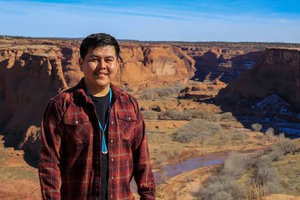
Born in Shiprock, New Mexico, and raised in Pinon, Arizona, on the Navajo Nation by parents who taught the Navajo language in public schools, Denny began losing his hearing at age 5. Because local schools on the reservation lacked certified ASL interpreters and Deaf peers, he grew up experiencing steep communication isolation until enrolling at the Arizona State Schools for the Deaf and the Blind in eighth grade, where seeing an entire campus signing opened the door to Deaf community and pride.
After earning degrees from Diné College and Gallaudet University, Denny joined Dr. McKay-Cody’s University of Arizona team as a research assistant in 2022 while completing his Master of Arts in Sign Language Education at Gallaudet. Alongside serving families in Northern Arizona and the Navajo Nation as a Deaf Mentor, he has helped edit and archive video entries for the digital dictionary while partnering with Navajo elders to document Navajo Sign Language.
In February 2023, following a nomination from Dr. McKay-Cody and the National Association of the Deaf, Denny brought Native sign language to Super Bowl LVII, performing “America the Beautiful” alongside Babyface in a blend of ASL and Plains Indian Sign Language.
“I just want to be able to inspire and empower those who are on their own to look around and see that there are other people out there who are just like them, and to not feel so isolated or lonely.” — Colin Denny, University of Arizona News
The Massachusetts Connection: How Local Algonquian Signing Shaped Deaf History
While Hand Talk is often associated with the Great Plains and Southwest, Indigenous visual communication has deep roots across the Northeast—including in the Southern New England homelands of the Narragansett and Pequot nations in Dr. McKay-Cody’s own maternal lineage. Before and during early European contact, Indigenous peoples across New England used manual sign communication alongside spoken Algonquian dialects for diplomacy and intertribal trade.
Off the southeastern coast of Massachusetts on Martha’s Vineyard—ancestral homeland of the Wampanoag people, who remain centered in Aquinnah—a distinct village signing community emerged in Chilmark starting in the late 18th century. For generations, both Deaf and hearing islanders used Martha’s Vineyard Sign Language (MVSL) on fishing boats, across farm fields, and in daily town life. After the American School for the Deaf opened in Hartford, Connecticut, in 1817, the first Deaf students from Martha’s Vineyard enrolled in 1825, bringing island signing into the wider New England Deaf community where American Sign Language (ASL) was taking shape.
Although popular histories have long suggested that Wampanoag signing may have influenced MVSL, recent archival and demographic research underscores that colonial displacement separated island communities and left Eastern Woodlands Algonquian signing completely unrecorded before MVSL itself faded in the mid-20th century. That irreversible loss right here in Massachusetts highlights why video documentation led by Deaf Native scholars—alongside local spoken reclamation efforts like the Wôpanâak Language Reclamation Project—is so urgent today.
Communication Access and Cultural Humility at Triangle, Inc.
The work of Dr. McKay-Cody and Colin Denny reminds us that language access and cultural identity cannot be separated. At Triangle, Inc., honoring communication diversity is woven into our daily work across Malden, Greater Boston, the North Shore, and the South Shore:
- Respecting Every Mode of Expression: Whether someone communicates through ASL, tribal or home sign systems, spoken languages, or Augmentative and Alternative Communication (AAC) devices, we support participants in leading conversations on their own terms.
- Practicing Cultural Humility: Just as Dr. McKay-Cody and Colin Denny center tribal sovereignty in every step of their archive, effective human services start with listening to communities and honoring their cultural frameworks around family, identity, and disability.
- Building Inclusive Pathways: Through our workforce development, youth leadership, and independent living programs, we partner with employers and neighbors to remove communication barriers so no one has to navigate school, work, or community life in isolation.
This Native American Heritage Month, Triangle, Inc. celebrates Dr. Melanie McKay-Cody, Colin Denny, and all Indigenous Deaf leaders keeping ancestral voices—and hands—alive for the next generation.